
Loading the document viewer…
Little-known documents that allow us to see past the marketing
Federal procurement
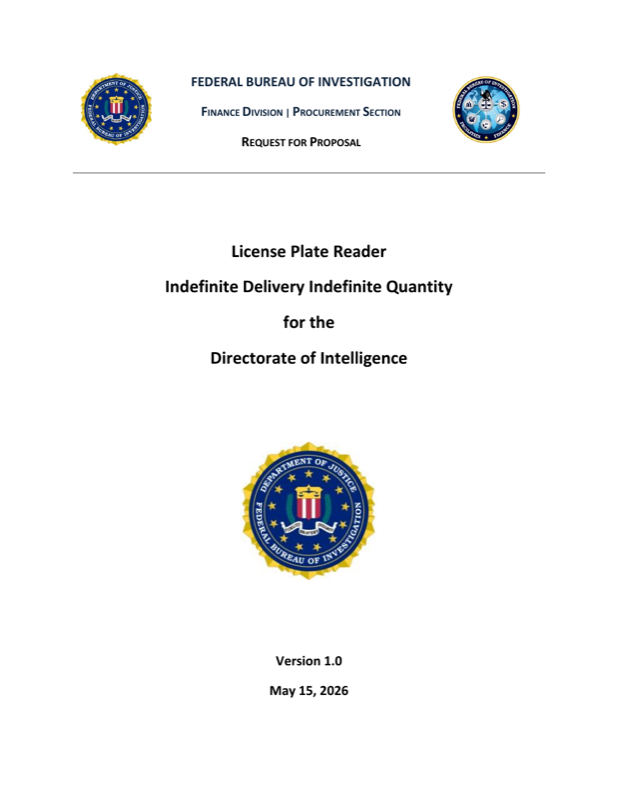
The FBI RFP
A nationwide request for near-real-time access to existing license-plate-reader data.
Read this storyGranted patent
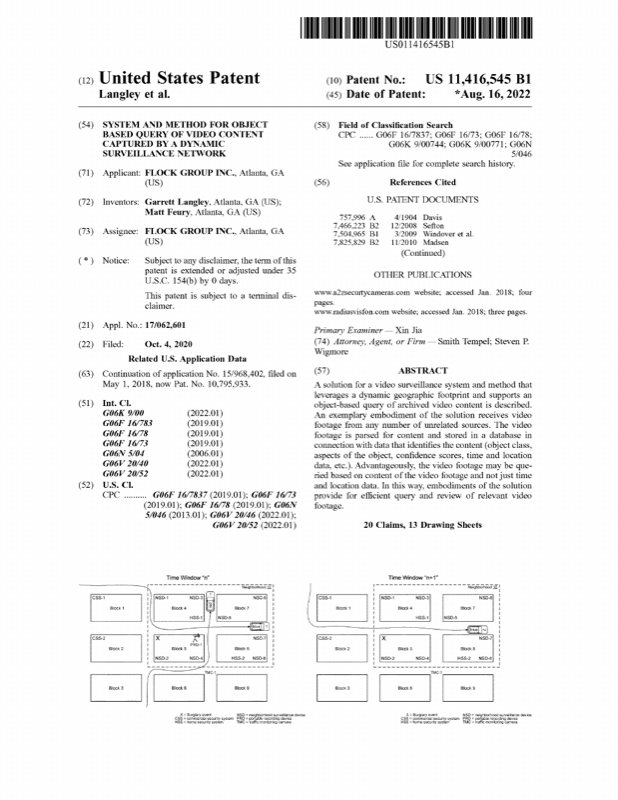
The Flock patent
A network design that describes searchable people, vehicles, and other objects across cameras.
Read this storyVendor guide
Flock coaches jurisdictions
The company’s own guide for briefing officials, answering critics, and preparing for council votes.
Read this storyThe reviewed notice shows no award yet, but the solicitation is an active pursuit of this capability. The requirements call for near-real-time data, persistent searches, alerts, geofencing, maps, image and video review, APIs, and large downloads. Access could extend across 56 FBI field offices and resident agencies, plus headquarters.
Contractors were asked to draw from as many sources as possible, including traffic, toll, commercial, repossession, red-light, speed, and law-enforcement cameras.
Question 10
Are you looking for access to an ALPR system already in place?
FBI answer
Yes
Question 29
The SOW references support for Open-Source Intelligence (OSINT) and social media-related capabilities; however, there does not appear to be a corresponding requirement or pricing structure tied to these capabilities. Can you confirm whether OSINT capabilities are expected to be included as part of the proposed solution, and if so, how they should be addressed within the pricing response?
FBI answer
OSINT is optional and pricing should reflect as such.
Question 30
The SOW references both law enforcement and commercially available LPR data sources. Can you clarify whether vendors are expected to provide both data types as part of their solution, or if offerings may be limited to one or the other depending on capability?
FBI answer
Vendors are not expected to have both but it would be beneficial.
Question 39
Should persistent searches, hotlists, and notification capabilities be proposed as: included core functionality, optional functionality, or separately priced capabilities?
FBI answer
Included core functionality
Question 43
Please clarify acceptable implementation approaches for “blind logging” requirements, including whether: encrypted audit logging, hashed query retention, or ephemeral query processing would satisfy the requirement.
FBI answer
Blind Logging is no retention or storage of any queries executed through logs, cache, or saved searches.
Question 46
Does the Government anticipate API usage primarily for: bulk export, system-to-system integration, alerting workflows, or operational query integration?
FBI answer
Potentially, all.
Question 47
The SOW references retention periods up to 120 days. Will longer historical retention periods be viewed favorably during technical evaluation?
FBI answer
We evalute based on the SOW.
Question 50
How will AI/ML capabilities be weighted relative to core operational LPR functionality during evaluation?
FBI answer
We evalute based on the SOW.
Read all 59 exchanges.
The patent is about searchable surveillance, not just license plates. Link to this section
Flock’s 2022 patent describes a dynamic camera network that turns video into searchable objects and attributes. Its examples extend well beyond the roadside readers sold to local governments.
Faces across camera networks
An example starts with a driver’s face in convenience-store footage and searches home-camera video for a person with matching face-recognition data points.
Specification, PDF p. 18
People and physical traits
The patent describes classifying people by sex and race, identifying clothing, and estimating height and weight. Another example searches by sex, clothing, date, and geographic zone.
Specification, PDF pp. 24 and 26
More than vehicles
Humans, animals, automobiles, and bicycles can be identified as objects, compared across cameras, placed on a timeline or map, and used to trigger an alert.
Specification, PDF pp. 18–19; claims 1 and 10
More than roadside readers
The described network can draw from neighborhood, home, commercial, traffic, smartphone, portable, and drone-mounted cameras—not only Flock roadside hardware.
Specification, PDF pp. 18–19; claim 5
Loading the document viewer…
Pages 3 and 5
Flock urges agencies to shape the story early — brief city managers and council members before votes, share policies in advance, and arrive with a carefully scripted presentation.
Page 6
The guide advises agencies not to get stuck disputing the term “mass surveillance,” and to spend less time on capabilities and more time describing governance, local needs, and safeguards.
Pages 9 and 11
Flock points to audit logs, sharing controls, and transparency portals while asserting that customers own their data and control opt-in sharing relationships.
Page 12
The guide acknowledges a case in which an early setup configuration unintentionally created access.
Page 14
Flock offers council-preparation calls and customer-support help for agencies facing local policy questions and public opposition.
References Link to this section
- US 11,416,545 B1, grant PDF Granted U.S. patent
- USPTO Patent Center, application 17/062,601 Official federal record
- Flock FreeForm product page Vendor representation
- Flock data and privacy page Vendor representation
- Flock Nova product page Vendor product description
- SAM.gov notice SHOP-PR-26-003385 Official federal solicitation
- Ars Technica review of the FBI RFP and statement of work Reporting on federal attachments
- Flock council guide on DocumentCloud Flock-branded document contributed by 404 Media